如何在 Android 的 webview 中获取 onclick 事件?
androidapps/applicationsmobile development更新于 2026/1/13 21:07:17
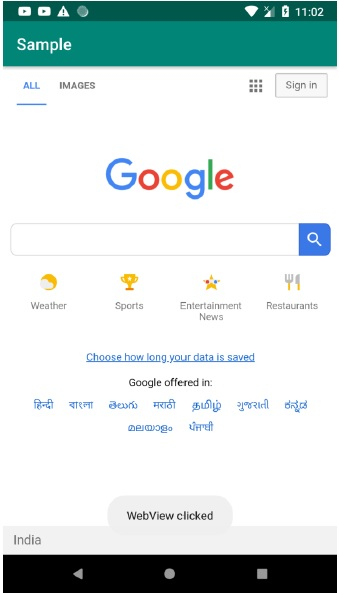
此示例演示了如何在 Android 的 webView 中获取 onClick 事件。
步骤 1 − 在 Android Studio 中创建一个新项目,前往"文件"->"新建项目",并填写所有必填信息以创建新项目。
步骤 2 − 将以下代码添加到 res/layout/activity_main.xml。
<?xml version="1.0" encoding="utf-8"?>
<LinearLayout xmlns:android="http://schemas.android.com/apk/res/android"
   xmlns:tools="http://schemas.android.com/tools"
   android:layout_width="match_parent"
   android:layout_height="match_parent"
   android:gravity="center"
   android:orientation="vertical"
   tools:context=".MainActivity">
<WebView
   android:id="@+id/webView"
   android:layout_width="match_parent"
   android:layout_height="match_parent" />
</LinearLayout>
步骤 3 − 将以下代码添加到 src/MainActivity.java
import androidx.appcompat.app.AppCompatActivity;
import android.os.Bundle;
import android.os.Handler;
import android.os.Message;
import android.view.MotionEvent;
import android.view.View;
import android.webkit.WebView;
import android.webkit.WebViewClient;
import android.widget.Toast;
public class MainActivity extends AppCompatActivity implements View.OnTouchListener,
Handler.Callback {
   private static final int CLICK_ON_WEBVIEW = 1;
   private static final int CLICK_ON_URL = 2;
   private final Handler handler = new Handler(this);
   WebView webView;
   WebViewClient client;
   @Override
   protected void onCreate(Bundle savedInstanceState) {
      super.onCreate(savedInstanceState);
      setContentView(R.layout.activity_main);
      webView = findViewById(R.id.webView);
      webView.setOnTouchListener(this);
      client = new WebViewClient() {
         @Override
         public boolean shouldOverrideUrlLoading(WebView view, String url) {
            handler.sendEmptyMessage(CLICK_ON_URL);
            return false;
         }
      };
      webView.setWebViewClient(client);
      webView.setVerticalScrollBarEnabled(false);
      webView.loadUrl("http://www.google.com");
   }
   @Override
   public boolean handleMessage(Message msg) {
      if (msg.what == CLICK_ON_URL) {
         handler.removeMessages(CLICK_ON_WEBVIEW);
         return true;
      }
      if (msg.what == CLICK_ON_WEBVIEW) {
         Toast.makeText(this, "WebView clicked", Toast.LENGTH_SHORT).show();
         return true;
      }
      return false;
   }
   @Override
   public boolean onTouch(View v, MotionEvent event) {
      if (v.getId() == R.id.webView && event.getAction() == MotionEvent.ACTION_DOWN) {
         handler.sendEmptyMessageDelayed(CLICK_ON_WEBVIEW, 500);
      }
      return false;
   }
}
步骤 4 − 将以下代码添加到 androidManifest.xml
<?xml version="1.0" encoding="utf-8"?>
<manifest xmlns:android="http://schemas.android.com/apk/res/android"
   package="app.com.sample">
   <uses-permission android:name="android.permission.INTERNET"/>
   <application
      android:allowBackup="true"
      android:icon="@mipmap/ic_launcher"
      android:label="@string/app_name"
      android:roundIcon="@mipmap/ic_launcher_round"
      android:supportsRtl="true"
      android:theme="@style/AppTheme">
      <activity android:name=".MainActivity">
         <intent-filter>
            <action android:name="android.intent.action.MAIN" />
            <category android:name="android.intent.category.LAUNCHER" />
         </intent-filter>
      </activity>
   </application>
</manifest>
让我们尝试运行您的应用程序。假设您已将实际的 Android 移动设备连接到电脑。要从 Android Studio 运行该应用程序,请打开项目的某个活动文件,然后点击工具栏上的"运行"图标  。选择您的移动设备作为选项,然后勾选将显示默认屏幕的移动设备。