
Aho-Corasick 算法
用于模式匹配的 Aho-Corasick 算法
Aho-Corasick 算法是一种字典匹配算法,可以在线性时间内找到给定文本中所有模式集合的所有出现位置。该算法由 Alfred V. Aho 和 Margaret J. Corasick 于 1975 年开发,广泛应用于恶意软件检测、文本分析和自然语言处理等应用领域。
Aho-Corasick 算法的工作原理是什么?
Aho-Corasick 算法只需遍历文本一次即可搜索所有模式,并且不会进行任何不必要的回溯。它可以处理不同长度的多个关键字,并且可以轻松处理重叠匹配。
该算法借助 trie 数据结构来跟踪搜索到的模式。 trie 是一种基于树的数据结构,主要用于存储字符串。
让我们通过一个例子来理解 −
输入:
模式集 = {their, there, any, bye}
主字符串 = "isthereanyanswerokgoodbye"
输出:
单词 there 位置:2
单词 any 位置:7
单词 bye 位置:22
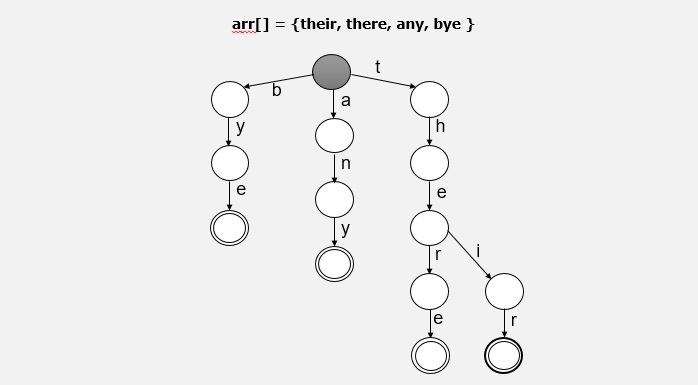
Aho-Corasick 算法包含以下步骤 −
- 预处理
- 搜索/匹配
预处理阶段
在预处理步骤中,我们根据关键词构建有限状态机(trie)。trie 为每个关键词的前缀创建一个节点,并为前缀的每个可能扩展创建一个以字符标记的边。trie 的根节点表示空前缀,最后一个节点标记为最终节点。
预处理步骤进一步分为三个子步骤 −
进入阶段 − 此阶段根据模式的特征定义状态之间的转换。它以二维数组的形式表示。
失败阶段 −它定义了不匹配发生时状态之间的转换。它表示为一个一维数组。
输出阶段 − 在此阶段,算法存储所有以给定状态结束的模式的索引。它也用一个一维数组表示。
搜索/匹配阶段
搜索步骤是通过从左到右扫描文本,并根据文本中的字符跟踪 trie 中的边和失败链接来完成的。每当我们到达最后一个节点时,我们就会报告文本中相应关键字的匹配。
示例
以下示例演示了 Aho-Corasick 算法在不同编程语言中的工作原理。
#include <stdio.h>
#include <string.h>
#define MAXS 500    // 所有模式的长度总和
#define MAXC 26     // 字母表中的 26 个字母
int output[MAXS];
int fail[MAXS];
int gotoMat[MAXS][MAXC];
int buildTree(char* array[], int size) {
   for(int i = 0; i<MAXS; i++)
      output[i] = 0;  // 输出数组的所有元素都为 0
   for(int i = 0; i<MAXS; i++)
      fail[i] = -1;  // 失败数组的所有元素都是-1
   for(int i = 0; i<MAXS; i++)
      for(int j = 0; j<MAXC; j++)
         gotoMat[i][j] = -1;  // goto矩阵的所有元素都是-1
   // 初始状态
   int state = 1;
   // 对数组中的所有模式建立 trie
   for (int i = 0; i < size; i++) {
      char* word = array[i];
      int presentState = 0;
      // 添加模式
      for (int j = 0; j < strlen(word); ++j) {
         int ch = word[j] - 'a';
         if (gotoMat[presentState][ch] == -1)
            // 增加状态
            gotoMat[presentState][ch] = state++;
         presentState = gotoMat[presentState][ch];
      }
      // 在输出中添加当前单词
      output[presentState] |= (1 << i);
   }
   // 如果 ch 没有直接连接到根节点
   for (int ch = 0; ch < MAXC; ++ch)
      if (gotoMat[0][ch] == -1)
         gotoMat[0][ch] = 0;
   // 节点发生故障时恢复到先前状态
   for (int ch = 0; ch < MAXC; ++ch) {
      if (gotoMat[0][ch] != 0) {
         fail[gotoMat[0][ch]] = 0;
         // 将下一级节点添加到队列
         int q[MAXS], front = 0, rear = 0;
         q[rear++] = gotoMat[0][ch];
         while (front != rear) {
            // 删除前节点
            int state = q[front++];
            for (int ch = 0; ch <= MAXC; ++ch) {
               // 如果存在 goto 状态
               if (gotoMat[state][ch] != -1) {
                  int failure = fail[state];
                  // 找到具有适当后缀的最深节点
                  while (gotoMat[failure][ch] == -1)
                     failure = fail[failure];
                  failure = gotoMat[failure][ch];
                  fail[gotoMat[state][ch]] = failure;
                  // 合并输出值
                  output[gotoMat[state][ch]] |= output[failure];
                  // 将下一级节点添加到队列
                  q[rear++] = gotoMat[state][ch];
               }
            }
         }
      }
   }
   return state;
}
int getNextState(int presentState, char nextChar) {
   int answer = presentState;
   int ch = nextChar - 'a'; //减去'a'的ascii
   // 如果未找到 go to,则使用失败函数
   while (gotoMat[answer][ch] == -1)
      answer = fail[answer];
   return gotoMat[answer][ch];
}
void patternSearch(char* arr[], int size, char* text) {
   buildTree(arr, size);  // 制作 trie 结构
   int presentState = 0;  // 使当前状态为 0
   // 查找所有出现的模式
   for (int i = 0; i < strlen(text); i++) {
      presentState = getNextState(presentState, text[i]);
      // 匹配找到并打印的单词
      for (int j = 0; j < size; ++j) {
         if (output[presentState] & (1 << j)) {
           printf("Word %s location: %zu
", arr[j], i - strlen(arr[j]) + 1);
         }
      }
   }
}
int main() {
   char* arr[] = {"their", "there", "answer", "any", "bye"};
   char* text = "isthereanyanswerokgoodbye";
   int k = sizeof(arr)/sizeof(arr[0]);
   patternSearch(arr, k, text);
   return 0;
}
#include <iostream>
#include <queue>
#define MAXS 500    // 所有模式的长度总和
#define MAXC 26     // 字母表中的 26 个字母
using namespace std;
int output[MAXS];
int fail[MAXS];
int gotoMat[MAXS][MAXC];
int buildTree(string array[], int size) {
   for(int i = 0; i<MAXS; i++)
      output[i] = 0;  // 输出数组的所有元素都为 0
   for(int i = 0; i<MAXS; i++)
      fail[i] = -1;  // 失败数组的所有元素都是-1
   for(int i = 0; i<MAXS; i++)
      for(int j = 0; j<MAXC; j++)
         gotoMat[i][j] = -1;  // goto矩阵的所有元素都是-1
   // 初始状态
   int state = 1;
   // 对数组中的所有模式建立 trie
   for (int i = 0; i < size; i++) {
      string word = array[i];
      int presentState = 0;
      // 添加模式
      for (int j = 0; j < word.size(); ++j) {
         int ch = word[j] - 'a';
         if (gotoMat[presentState][ch] == -1)
            // 增加状态
            gotoMat[presentState][ch] = state++;
         presentState = gotoMat[presentState][ch];
      }
      // 在输出中添加当前单词
      output[presentState] |= (1 << i);
   }
   // 如果 ch 没有直接连接到根节点
   for (int ch = 0; ch < MAXC; ++ch)
      if (gotoMat[0][ch] == -1)
         gotoMat[0][ch] = 0;
   queue<int> q;
   // 节点发生故障时恢复到先前状态
   for (int ch = 0; ch < MAXC; ++ch) {
      if (gotoMat[0][ch] != 0) {
         fail[gotoMat[0][ch]] = 0;
         q.push(gotoMat[0][ch]);
      }
   }
   while (q.size()) {
      // 删除前节点
      int state = q.front();
      q.pop();
      for (int ch = 0; ch <= MAXC; ++ch) {
         // 如果存在 goto 状态
         if (gotoMat[state][ch] != -1) {
            int failure = fail[state];
            // 找到具有适当后缀的最深节点
            while (gotoMat[failure][ch] == -1)
               failure = fail[failure];
               failure = gotoMat[failure][ch];
               fail[gotoMat[state][ch]] = failure;
               // 合并输出值
               output[gotoMat[state][ch]] |= output[failure];
               // 将下一级节点添加到队列
               q.push(gotoMat[state][ch]);
         }
      }
   }
   return state;
}
int getNextState(int presentState, char nextChar) {
   int answer = presentState;
   int ch = nextChar - 'a'; //减去'a'的ascii
   // 如果未找到 go to,则使用失败函数
   while (gotoMat[answer][ch] == -1)
      answer = fail[answer];
   return gotoMat[answer][ch];
}
void patternSearch(string arr[], int size, string text) {
   buildTree(arr, size);  // 制作 trie 结构
   int presentState = 0;  // 使当前状态为 0
   // 查找所有出现的模式
   for (int i = 0; i < text.size(); i++) {
      presentState = getNextState(presentState, text[i]);
      // 匹配找到并打印的单词
      for (int j = 0; j < size; ++j) {
         if (output[presentState] & (1 << j)) {
            cout << "Word " << arr[j] << " location: " << i - arr[j].size() + 1 << endl;
         }
      }
   }
}
int main() {
   string arr[] = {"their", "there", "answer", "any", "bye"};
   string text = "isthereanyanswerokgoodbye";
   int k = sizeof(arr)/sizeof(arr[0]);
   patternSearch(arr, k, text);
   return 0;
}
import java.util.*;
public class Main {
   static final int MAXS = 500; // 所有模式的长度总和
   static final int MAXC = 26;  // 字母表中的 26 个字母
   static int[] output = new int[MAXS];
   static int[] fail = new int[MAXS];
   static int[][] gotoMat = new int[MAXS][MAXC];
   // method to construct trie
   static int buildTree(String[] array, int size) {
      for(int i = 0; i<MAXS; i++)
         output[i] = 0;  // 输出数组的所有元素都为 0
      for(int i = 0; i<MAXS; i++)
         fail[i] = -1;  // 失败数组的所有元素都是-1
      for(int i = 0; i<MAXS; i++)
         for(int j = 0; j<MAXC; j++)
            gotoMat[i][j] = -1;  // goto矩阵的所有元素都是-1
        // 初始状态
        int state = 1;
        // 对数组中的所有模式建立 trie
        for (int i = 0; i < size; i++) {
            String word = array[i];
            int presentState = 0;
            // 添加模式
            for (int j = 0; j < word.length(); ++j) {
                int ch = word.charAt(j) - 'a';
                if (gotoMat[presentState][ch] == -1)
                    // 增加状态
                    gotoMat[presentState][ch] = state++;
                presentState = gotoMat[presentState][ch];
            }
            // 在输出中添加当前单词
            output[presentState] |= (1 << i);
        }
        // 如果 ch 没有直接连接到根节点
        for (int ch = 0; ch < MAXC; ++ch)
            if (gotoMat[0][ch] == -1)
                gotoMat[0][ch] = 0;
        Queue<Integer> q = new LinkedList<>();
        // 节点发生故障时恢复到先前状态
        for (int ch = 0; ch < MAXC; ++ch) {
            if (gotoMat[0][ch] != 0) {
                fail[gotoMat[0][ch]] = 0;
                q.add(gotoMat[0][ch]);
            }
        }
        while (!q.isEmpty()) {
            // 删除前节点
            state = q.poll();
            for (int ch = 0; ch < MAXC; ++ch) {
                // 如果存在 goto 状态
                if (gotoMat[state][ch] != -1) {
                    int failure = fail[state];
                    // 找到具有适当后缀的最深节点
                    while (gotoMat[failure][ch] == -1)
                        failure = fail[failure];
                    failure = gotoMat[failure][ch];
                    fail[gotoMat[state][ch]] = failure;
                    // 合并输出值
                    output[gotoMat[state][ch]] |= output[failure];
                    // 将下一级节点添加到队列
                    q.add(gotoMat[state][ch]);
                }
            }
        }
        return state;
    }
    static int getNextState(int presentState, char nextChar) {
        int answer = presentState;
        int ch = nextChar - 'a'; //减去'a'的ascii
        // 如果未找到 go to,则使用失败函数
        while (gotoMat[answer][ch] == -1)
            answer = fail[answer];
        return gotoMat[answer][ch];
    }
    static void patternSearch(String[] arr, int size, String text) {
        buildTree(arr, size);  // 制作 trie 结构
        int presentState = 0;  // 使当前状态为 0
        // 查找所有出现的模式
        for (int i = 0; i < text.length(); i++) {
            presentState = getNextState(presentState, text.charAt(i));
            // 匹配找到并打印的单词
            for (int j = 0; j < size; ++j) {
                if ((output[presentState] & (1 << j)) != 0) {
                    System.out.println("Word " + arr[j] + " location: " + (i - arr[j].length() + 1));
                }
            }
        }
    }
    public static void main(String[] args) {
        String[] arr = {"their", "there", "answer", "any", "bye"};
        String text = "isthereanyanswerokgoodbye";
        int k = arr.length;
        patternSearch(arr, k, text);
    }
}
from collections import deque
MAXS = 500    # 所有模式的长度总和
MAXC = 26     # 字母表中的 26 个字母
output = [0]*MAXS
fail = [-1]*MAXS
gotoMat = [[-1]*MAXC for _ in range(MAXS)]
# 构造 trie 的函数
def buildTree(array):
    global output, fail, gotoMat
    size = len(array)
    # 初始状态
    state = 1
    # 对数组中的所有模式建立 trie
    for i in range(size):
        word = array[i]
        presentState = 0
        # adding pattern
        for j in range(len(word)):
            ch = ord(word[j]) - ord('a')
            if gotoMat[presentState][ch] == -1:
                # increasing state
                gotoMat[presentState][ch] = state
                state += 1
            presentState = gotoMat[presentState][ch]
        # 在输出中添加当前单词
        output[presentState] |= (1 << i)
    # 如果 ch 没有直接连接到根节点
    for ch in range(MAXC):
        if gotoMat[0][ch] == -1:
            gotoMat[0][ch] = 0
    q = deque()
    # 节点发生故障时恢复到先前状态
    for ch in range(MAXC):
        if gotoMat[0][ch] != 0:
            fail[gotoMat[0][ch]] = 0
            q.append(gotoMat[0][ch])
    while q:
        # 删除前节点
        state = q.popleft()
        for ch in range(MAXC):
            # 如果存在 goto 状态
            if gotoMat[state][ch] != -1:
                failure = fail[state]
                # 找到具有适当后缀的最深节点
                while gotoMat[failure][ch] == -1:
                    failure = fail[failure]
                failure = gotoMat[failure][ch]
                fail[gotoMat[state][ch]] = failure
                # 合并输出值
                output[gotoMat[state][ch]] |= output[failure]
                # 将下一级节点添加到队列
                q.append(gotoMat[state][ch])
    return state

def getNextState(presentState, nextChar):
    answer = presentState
    ch = ord(nextChar) - ord('a') #subtract ascii of 'a'
    # 如果未找到 go to,则使用失败函数
    while gotoMat[answer][ch] == -1:
        answer = fail[answer]
    return gotoMat[answer][ch]

def patternSearch(arr, text):
    buildTree(arr)  # 制作 trie 结构
    presentState = 0  # 使当前状态为 0
    size = len(arr)
    # 查找所有出现的模式
    for i in range(len(text)):
        presentState = getNextState(presentState, text[i])
        # 匹配找到并打印的单词
        for j in range(size):
            if (output[presentState] & (1 << j)) != 0:
                print(f"Word {arr[j]} location: {i - len(arr[j]) + 1}")

def main():
    arr = ["their", "there", "answer", "any", "bye"]
    text = "isthereanyanswerokgoodbye"
    patternSearch(arr, text)

if __name__ == "__main__":
    main()
输出
Word there location: 2
Word any location: 7
Word answer location: 10
Word bye location: 22