
集合覆盖问题
集合覆盖算法为许多现实世界的资源分配问题提供了解决方案。例如,假设一家航空公司为每架飞机分配机组人员,以确保有足够的人员满足旅程的需求。他们会考虑航班时间、飞行时长、中途停留次数以及机组人员的空闲时间,从而将他们分配到各个航班。这时,集合覆盖算法就派上用场了。
给定一个通用集合 U,其中包含少量元素,这些元素都被划分为子集。假设这些子集的集合为 S = {S1, S2, S3, S4... Sn},集合覆盖算法会找到最小数量的子集,使得它们覆盖全集中存在的所有元素。
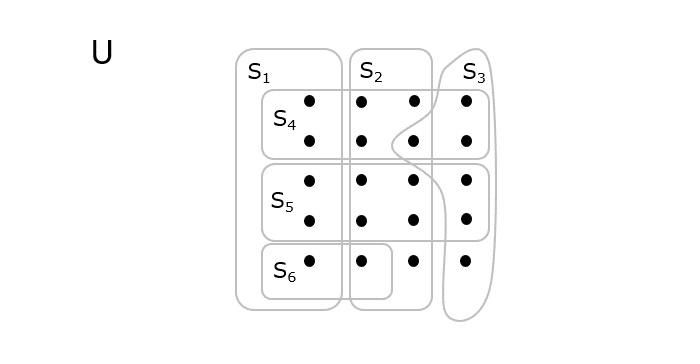
如上图所示,点表示全集 U 中存在的元素,这些元素被划分到不同的集合中,S = {S1, S2, S3, S4, S5, S6}。需要选择的最小集合数来覆盖所有元素,即最优输出 = {S1, S2, S3}。
集合覆盖算法
集合覆盖算法以集合集合作为输入,返回包含所有通用元素所需的最小集合数。
集合覆盖算法是一个 NP-Hard 问题,也是一个 2 近似贪婪算法。
算法
步骤 1 − 初始化 Output = {},其中 Output 表示元素的输出集合。
步骤 2 −如果输出集未包含全集的所有元素,请执行以下操作 −
使用公式 $\frac{Cost\left ( S_{i} ight )}{S_{i}-Output}$ 计算全集中每个子集的成本效益
在每次迭代中,找到成本效益最低的子集。将该子集添加到输出集。
步骤 3 − 重复步骤 2,直到全集中没有剩余元素。获得的输出即为最终的输出集。
伪代码
APPROX-GREEDY-SET_COVER(X, S)
   U = X
   OUTPUT = ф
   while U ≠ ф
      select Si Є S which has maximum |Si∩U|
   U = U – S
   OUTPUT = OUTPUT∪ {Si}
return OUTPUT
分析
假设元素总数等于集合总数 (|X| = |S|),则代码运行时间为 O(|X|3)
示例
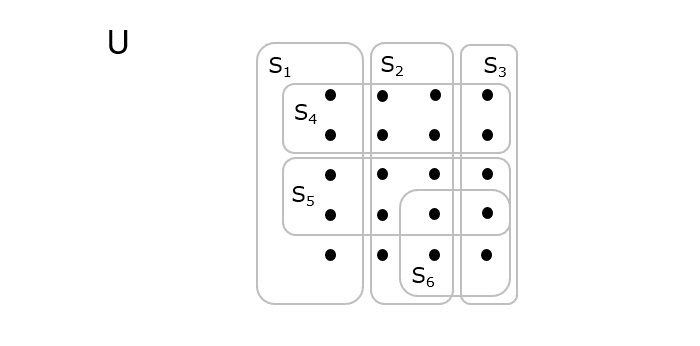
让我们看一个示例,更详细地描述集合覆盖问题的近似算法
S1 = {1, 2, 3, 4}                cost(S1) = 5
S2 = {2, 4, 5, 8, 10}            cost(S2) = 10
S3 = {1, 3, 5, 7, 9, 11, 13}     cost(S3) = 20
S4 = {4, 8, 12, 16, 20}          cost(S4) = 12
S5 = {5, 6, 7, 8, 9}             cost(S5) = 15
步骤 1
输出集,Output = ф
当输出集中没有元素时,计算每个集合的成本效益
S1 = cost(S1) / (S1 – Output) = 5 / (4 – 0)
S2 = cost(S2) / (S2 – Output) = 10 / (5 – 0)
S3 = cost(S3) / (S3 – Output) = 20 / (7 – 0)
S4 = cost(S4) / (S4 – Output) = 12 / (5 – 0)
S5 = cost(S5) / (S5 – Output) = 15 / (5 – 0)
本次迭代的最小成本效益在 S1 处实现,因此,添加到输出集的子集 Output = {S1},其元素为 {1, 2, 3, 4}。
步骤 2
计算输出集中新元素对每个集合的成本效益。
S2 = cost(S2) / (S2 – Output) = 10 / (5 – 4)
S3 = cost(S3) / (S3 – Output) = 20 / (7 – 4)
S4 = cost(S4) / (S4 – Output) = 12 / (5 – 4)
S5 = cost(S5) / (S5 – Output) = 15 / (5 – 4)
本次迭代的最小成本效益在 S3 处实现,因此,将子集添加到输出集,输出 = {S1, S3},其元素为 {1, 2, 3, 4, 5, 7, 9, 11, 13}。
步骤 3
计算输出集中新元素对每个集合的成本效益,
S2 = cost(S2) / (S2 – 输出) = 10 / |(5 – 9)|
S4 = cost(S4) / (S4 – 输出) = 12 / |(5 – 9)|
S5 = cost(S5) / (S5 – Output) = 15 / |(5 – 9)|
本次迭代的最小成本效益在 S2 处实现,因此,添加到输出集的子集 Output = {S1, S3, S2},其元素为 {1, 2, 3, 4, 5, 7, 8, 9, 10, 11, 13}。
步骤 4
计算输出集中新元素对每个集合的成本效益。
S4 = cost(S4) / (S4 – Output) = 12 / |(5 – 11)|
S5 = cost(S5) / (S5 – Output) = 15 / |(5 – 11)|
本次迭代的最小成本效益在 S4 处实现,因此,添加到输出集的子集输出 = {S1, S3, S2, S4},其元素为 {1, 2, 3, 4, 5, 7, 8, 9, 10, 11, 12, 13, 16, 20
步骤 5
计算输出集中新元素对每个集合的成本效益
S5 = cost(S5) / (S5 – Output) = 15 / |(5 – 14)|
本次迭代的最小成本效益在 S5 处实现,因此,添加到输出集的子集 Output = {S1, S3, S2, S4, S5},其元素为 {1, 2, 3, 4, 5, 6, 7, 8, 9, 10, 11, 12, 13, 16, 20
覆盖通用有限集中所有元素的最终输出为 Output = {S1, S3, S2, S4, S5}。
实现
以下是实现上述方法在各种编程语言中的应用 −
#include <stdio.h>
#define MAX_SETS 100
#define MAX_ELEMENTS 1000
int setCover(int X[], int S[][MAX_ELEMENTS], int numSets, int numElements, int output[]) {
   int U[MAX_ELEMENTS];
   for (int i = 0; i < numElements; i++) {
      U[i] = X[i];
   }
   int selectedSets[MAX_SETS];
   for (int i = 0; i < MAX_SETS; i++) {
      selectedSets[i] = 0; // 全部初始化为0(未选择)
   }
   int outputIdx = 0;
   while (outputIdx < numSets) {  // 确保不超过最大组数
      int maxIntersectionSize = 0;
      int selectedSetIdx = -1;
      // 找到与 U 有最大交集的集合 Si
      for (int i = 0; i < numSets; i++) {
         if (selectedSets[i] == 0) { // 检查集合是否尚未被选择
            int intersectionSize = 0;
            for (int j = 0; j < numElements; j++) {
               if (U[j] && S[i][j]) {
                  intersectionSize++;
               }
            }
            if (intersectionSize > maxIntersectionSize) {
               maxIntersectionSize = intersectionSize;
               selectedSetIdx = i;
            }
         }
      }
      // 如果没有找到集合,则中断循环
      if (selectedSetIdx == -1) {
          break;
      }
      // 在数组中将选定的集合标记为“选定”
      selectedSets[selectedSetIdx] = 1;
      // 从 U 中删除选定集合所覆盖的元素
      for (int j = 0; j < numElements; j++) {
          U[j] = U[j] - S[selectedSetIdx][j];
      }
      // 将选定的集合添加到输出
      output[outputIdx++] = selectedSetIdx;
   }
   return outputIdx;
}
int main() {
   int X[MAX_ELEMENTS] = {1, 2, 3, 4, 5, 6, 7, 8, 9, 10};
   int S[MAX_SETS][MAX_ELEMENTS] = {
      {1, 1, 0, 0, 0, 0, 0, 0, 0, 0},
      {0, 1, 1, 1, 0, 0, 0, 0, 0, 0},
      {0, 0, 0, 1, 1, 1, 0, 0, 0, 0},
      {0, 0, 0, 0, 0, 1, 1, 1, 0, 0},
      {0, 0, 0, 0, 0, 0, 0, 1, 1, 1}
   };
   int numSets = 5;
   int numElements = 10;
   int output[MAX_SETS];
   int numSelectedSets = setCover(X, S, numSets, numElements, output);
   printf("Selected Sets: ");
   for (int i = 0; i < numSelectedSets; i++) {
      printf("%d ", output[i]);
   }
   printf("
");
   return 0;
}
输出
Selected Sets: 1 2 3 4 0
#include <iostream>
#include <vector>
using namespace std;
#define MAX_SETS 100
#define MAX_ELEMENTS 1000
// 使用近似贪婪集合覆盖算法查找集合覆盖的函数
int setCover(int X[], int S[][MAX_ELEMENTS], int numSets, int numElements, int output[])
{
   int U[MAX_ELEMENTS];
   for (int i = 0; i < numElements; i++) {
      U[i] = X[i];
   }
   int selectedSets[MAX_SETS];
   for (int i = 0; i < MAX_SETS; i++) {
      selectedSets[i] = 0; // 全部初始化为0(未选择)
   }
   int outputIdx = 0;
   while (outputIdx < numSets) {  // 确保不超过最大组数
      int maxIntersectionSize = 0;
      int selectedSetIdx = -1;
      // 找到与 U 有最大交集的集合 Si
      for (int i = 0; i < numSets; i++) {
         if (selectedSets[i] == 0) { // 检查集合是否尚未被选择
            int intersectionSize = 0;
            for (int j = 0; j < numElements; j++) {
               if (U[j] && S[i][j]) {
                  intersectionSize++;
               }
            }
            if (intersectionSize > maxIntersectionSize) {
               maxIntersectionSize = intersectionSize;
               selectedSetIdx = i;
            }
         }
      }
      // 如果没有找到集合,则中断循环
      if (selectedSetIdx == -1) {
         break;
      }
      // 在数组中将选定的集合标记为“选定”
      selectedSets[selectedSetIdx] = 1;
      // 从 U 中删除选定集合所覆盖的元素
      for (int j = 0; j < numElements; j++) {
         U[j] = U[j] - S[selectedSetIdx][j];
      }
      // 将选定的集合添加到输出
      output[outputIdx++] = selectedSetIdx;
   }
   return outputIdx;
}
int main()
{
   int X[MAX_ELEMENTS] = {1, 2, 3, 4, 5, 6, 7, 8, 9, 10};
   int S[MAX_SETS][MAX_ELEMENTS] = {
      {1, 1, 0, 0, 0, 0, 0, 0, 0, 0},
      {0, 1, 1, 1, 0, 0, 0, 0, 0, 0},
      {0, 0, 0, 1, 1, 1, 0, 0, 0, 0},
      {0, 0, 0, 0, 0, 1, 1, 1, 0, 0},
      {0, 0, 0, 0, 0, 0, 0, 1, 1, 1}
   };
   int numSets = 5;
   int numElements = 10;
   int output[MAX_SETS];
   int numSelectedSets = setCover(X, S, numSets, numElements, output);
   cout << "Selected Sets: ";
   for (int i = 0; i < numSelectedSets; i++) {
       cout << output[i] << " ";
   }
   cout << endl;
   return 0;
}
输出
Selected Sets: 1 2 3 4 0
import java.util.*;
public class SetCover {
   public static List<Integer> setCover(int[] X, int[][] S) {
      Set<Integer> U = new HashSet<>();
      for (int x : X) {
         U.add(x);
      }
      List<Integer> output = new ArrayList<>();
      while (!U.isEmpty()) {
         int maxIntersectionSize = 0;
         int selectedSetIdx = -1;
         for (int i = 0; i < S.length; i++) {
            int intersectionSize = 0;
            for (int j = 0; j < S[i].length; j++) {
               if (U.contains(S[i][j])) {
                  intersectionSize++;
               }
            }
            if (intersectionSize > maxIntersectionSize) {
               maxIntersectionSize = intersectionSize;
               selectedSetIdx = i;
            }
         }
         if (selectedSetIdx == -1) {
            break;
         }
         for (int j = 0; j < S[selectedSetIdx].length; j++) {
            U.remove(S[selectedSetIdx][j]);
         }
         output.add(selectedSetIdx);
      }
      return output;
   }
public static void main(String[] args) {
   int[] X = {1, 2, 3, 4, 5, 6, 7, 8, 9, 10};
   int[][] S = {
      {1, 2},
      {2, 3, 4},
      {4, 5, 6},
      {6, 7, 8},
      {8, 9, 10}
   };
   List<Integer> selectedSets = setCover(X, S);
   System.out.print("Selected Sets: ");
   for (int idx : selectedSets) {
      System.out.print(idx + " ");
   }
   System.out.println();
   }
}
输出
Selected Sets: 1 3 4 0 2
def set_cover(X, S):
    U = set(X)
    output = []
    while U:
        max_intersection_size = 0
        selected_set_idx = -1
        for i, s in enumerate(S):
            intersection_size = len(U.intersection(s))
            if intersection_size > max_intersection_size:
                max_intersection_size = intersection_size
                selected_set_idx = i
        if selected_set_idx == -1:
            break
        U = U - set(S[selected_set_idx])
        output.append(selected_set_idx)
    return output
if __name__ == "__main__":
    X = [1, 2, 3, 4, 5, 6, 7, 8, 9, 10]
    S = [
        {1, 2},
        {2, 3, 4},
        {4, 5, 6},
        {6, 7, 8},
        {8, 9, 10}
    ]
    selected_sets = set_cover(X, S)
    print("Selected Sets:", selected_sets)
输出
Selected Sets: 1 3 4 0 2

